Start here
Fado in Porto vs Lisbon fado
Where to hear fado in Porto, what separates Lisbon fado from Coimbra fado, and what an hour in the Trindade Noble Hall gives you to listen to.
Book the Noble Hall concert ↗Quick answer
You hear fado in Porto at concerts and in small fado venues, and it is the same song form that grew up in Lisbon. The sources name two traditions, Lisbon's and Coimbra's. Women and men both sing in the Lisbon tradition, with the Portuguese guitar answering the voice. Coimbra fado is tied to the university and traditionally the preserve of male singers. The Noble Hall concert near Avenida dos Aliados is one hour with a singer, guitarists and a glass of port.
The short answer
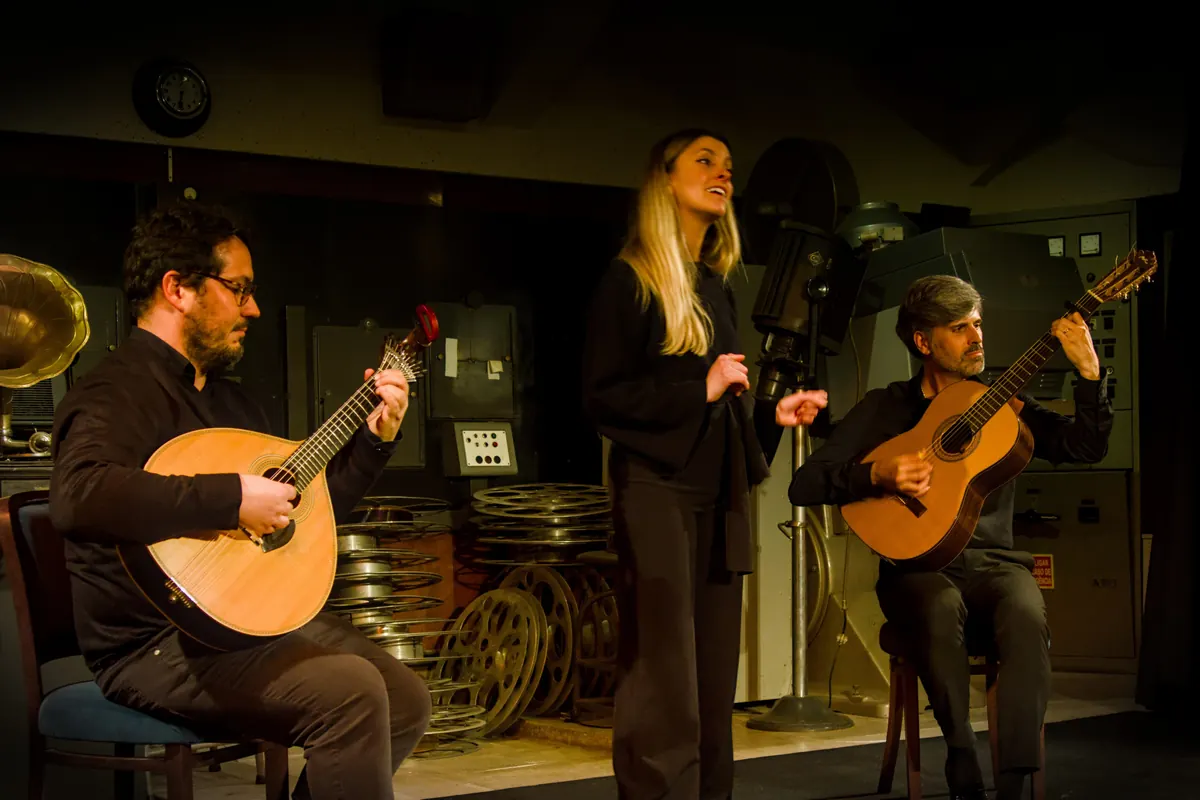
Fado can be heard in Porto, and what you hear there is the same song form as in Lisbon. The two traditions that sources give names to are Lisbon's and Coimbra's. Wikipedia calls the Lisbon style the better known of the two, and UNESCO describes fado as widely practised by communities in Lisbon. A concert in Porto belongs to that tradition rather than to a style of its own. This guide sets out what fado is, how the two traditions differ, and what the Noble Hall concert near Avenida dos Aliados puts in front of you.
What fado is
Wikipedia describes fado as a Portuguese music genre and says the word is often glossed as destiny or fate, possibly from the Latin fatum. It traces the genre to the 1820s in Lisbon, while noting that it probably has earlier roots and that early history was passed on by word of mouth. It grew up in Lisbon's bohemian districts, among them Bairro Alto, Mouraria and Alfama, and its early performers were mostly urban working people, including sailors and tavern regulars. The mood is loosely captured by saudade, a word for longing and a feeling of permanent loss. Wikipedia adds that fado uses major or minor harmony and often moves between the two.
Why people say Lisbon
In 2011 fado entered the UNESCO list of humanity's intangible heritage, the Representative List. The entry describes a performance genre joining music and poetry, practised by many communities in Lisbon. As ingredients it names Afro-Brazilian dance-songs, local songs and dances, country music carried to the city by migrants, and the song of the towns in the early 1800s. The same text says professionals perform it on stage and in small fado houses, whereas amateurs keep it going in neighbourhood associations of older Lisbon districts. Wikipedia notes that emigration and the world music circuit have carried fado far beyond the city, as a symbol of Portuguese identity.
Two names to know
Two historical names recur in every account. Wikipedia credits Maria Severa, a fadista of the nineteenth century, with helping to make the genre famous, and describes Amália Rodrigues as the Queen of Fado, the Rainha do Fado, whose recordings and tours carried it abroad. Both names come up wherever fado is discussed, in Porto as in Lisbon. They belong to the history rather than to any one programme, and the Noble Hall hour does not depend on knowing them.
The second tradition: Coimbra
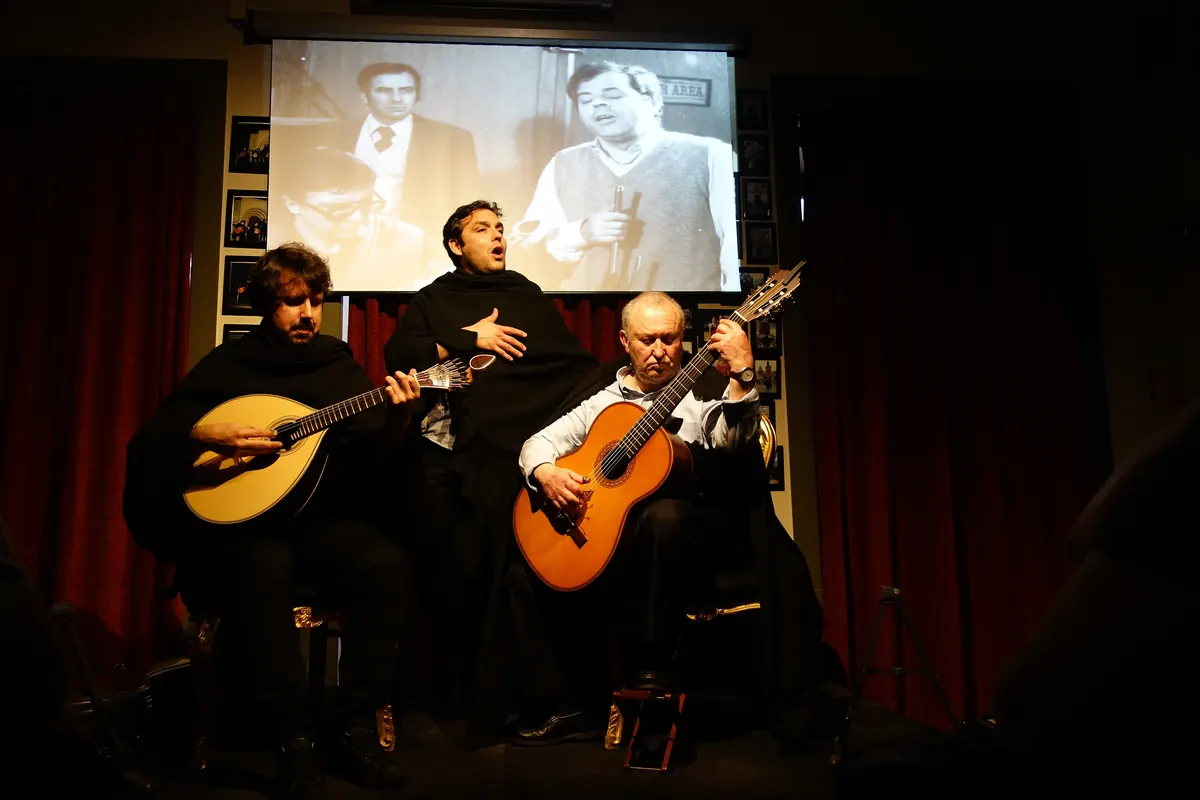
Wikipedia says Coimbra fado is traditionally tied to the University of Coimbra and is sung only by male singers. The Portuguese Wikipedia article adds that singers and musicians wear academic dress, black trousers and a black gown under a black wool cape, and that the songs are sung at night, in near darkness, in squares or streets. Serenades under the window of the woman the singer hopes to win are a traditional form. The most typical spot, the Portuguese article says, is the square beside the Sé Velha in Coimbra. Its themes include student love and love of the city, alongside broader questions about the human condition.
How the two sound different
The difference lies in the guitars as much as in the singers. Wikipedia's article on the Portuguese guitar gives the tuning as D in Lisbon and C in Coimbra, a major second apart, with the Lisbon instrument brighter and more ringing and the Coimbra one darker. In the Lisbon way, the guitarist opens with an introduction and then trades short phrases with the singer in call and response. In the Coimbra way, the guitar strums chords beside an acoustic guitar and never answers the singer's lines.
So what is Porto fado?
The sources do not describe a third, Porto tradition, and this guide does not invent one. What Porto offers is places to hear the existing ones: concert halls, rooms in historic buildings and small venues, the same settings UNESCO names when it says fado is staged in concert settings and in small fado houses. Which songs a singer chooses is the singer's decision, and programmes change from one evening to the next. For a visitor the useful question is therefore not which style Porto has but what kind of room and what kind of hour you want.
What the Noble Hall concert offers
The ticket is for a one-hour fado concert in the Noble Hall, the Salão Nobre, of the Ordem da Trindade. A professional singer and guitarists perform, and between songs the singer explains fado and its instruments. One glass of port is included, chosen from four styles: dry white, white, rosé and ruby. Seating is limited, no lunch or dinner is included, and the host speaks Portuguese, English, Spanish and French. The hall sits beside Praça da Trindade, a short way from the top of Avenida dos Aliados.
What you will hear
Whatever the programme, the same parts recur from song to song and from singer to singer. An hour in a hall gives you all of them in a small space, and because the singer explains fado and its instruments between the songs, you can name each part as it passes. Listen for these five things, roughly in this order of attention. The Lisbon fado house A Severa asks guests for total silence and a silent phone during the songs, and the same courtesy suits a seated concert.
- One voice, usually a solo singer, male or female, according to UNESCO
- The Portuguese guitar, twelve metal strings grouped as six pairs
- The viola, an acoustic guitar, underneath it
- Rubato: a note held at the end of a phrase for effect
- Saudade, the longing that most songs return to
Who this isn't for
Wheelchair users cannot book the Noble Hall ticket, because the booking marks it as unsuitable for them. It will not please anyone who wants dinner with the music, since no meal is included. It is a seated hour in one room, not a long night in a fado house. And if you want the student serenade of Coimbra, in capes and in the open air, a hall cannot give you that setting whatever the repertoire. A long evening with several singers, food and wine belongs to a different kind of venue.
Booking
Choose a date in the calendar below. Cancel at least a day ahead and your money comes back, or hold a date now and pay later. Seating is limited, so popular dates may go first. The meeting point is Praça da Trindade 182, and the show no longer takes place at São Bento station, whatever the web address of the booking page or an older review suggests. The calendar shows prices in your own currency, so none appear in this guide.
Frequently asked questions
Where can you hear fado in Porto?
At concerts and in small fado venues. UNESCO describes fado as staged in concert settings and in small fado houses. The Noble Hall near Avenida dos Aliados is one option, and the calendar shows its open dates.
Is there a separate Porto style of fado?
The sources name two traditions, Lisbon's and Coimbra's, and describe no separate Porto style. A concert in Porto belongs to the same song form.
How does Coimbra fado differ from Lisbon fado?
Coimbra fado is tied to the university, traditionally sung only by male singers in academic dress, and its guitar is tuned a tone lower. Women and men both sing in the Lisbon tradition.
Do I need Portuguese to follow it?
No. The host also speaks English, Spanish and French, and the singer explains fado and its instruments between the songs.
What is saudade?
A Portuguese word for longing, a feeling of missing something or someone absent. Wikipedia says it is intertwined with fado in Portuguese culture.
Can I take photos or talk during a song?
The fado house A Severa asks for total silence and a silent phone during songs. Follow the host's instructions in the room.
Sources